
An account number identifies your account at your bank; an IBAN identifies it worldwide. Your domestic account number works inside one country's payment system. The IBAN wraps that same account number in an international envelope: country code + check digits + the national number (BBAN): so any bank on earth can parse and verify it.
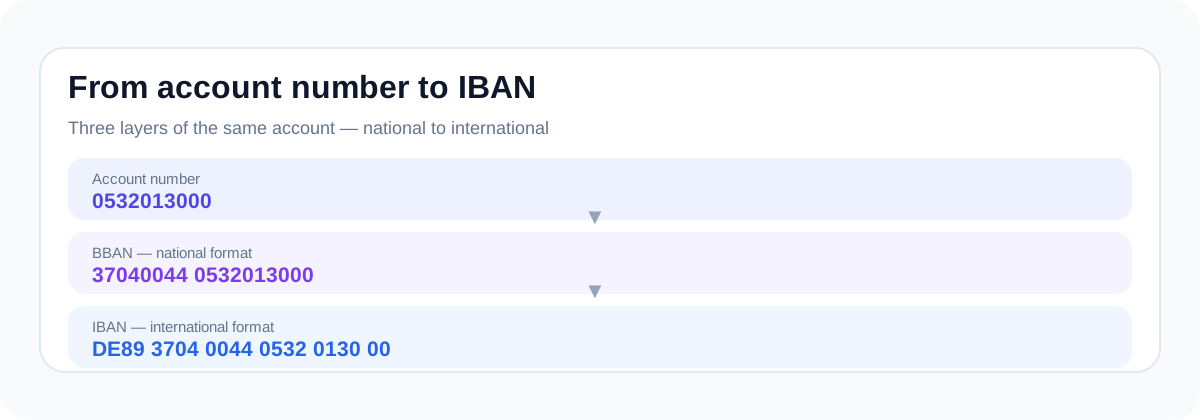
The three layers
| Layer | Example (Germany) | Scope |
|---|---|---|
| Account number | 0532013000 | One bank |
| BBAN (national) | 37040044 0532013000 | One country |
| IBAN (international) | DE89 3704 0044 0532 0130 00 | Worldwide |
Why not just use the account number everywhere?
Because account numbers collide across borders and carry no error detection. Two banks in two countries can each have account "0532013000". The IBAN's country code disambiguates them, and its mod-97 check digits catch typos before money moves: protection a bare account number cannot offer. Learn more in check digits explained.
What you will be asked for
- Domestic transfer (same country): often just the account number (+ sort code / Bankleitzahl).
- SEPA transfer: the full IBAN (BIC usually derived automatically).
- International (non-SEPA): IBAN (or account number) plus the bank's SWIFT/BIC code.
- US transfers: routing number + account number: the US does not use IBAN at all.
Finding yours
Your IBAN is printed on bank statements and in your banking app under "account details". If you only have the national number, our IBAN calculator converts BBAN to IBAN with correct check digits. Full guide: how to find your IBAN.
Compare the same account in two representations
For the German documentation example DE89370400440532013000, the account component is 0532013000. The full IBAN also contains DE, international check digits 89 and bank code 37040044. Supplying only the account component removes the information that identifies the country and bank layout.
Choose the field the payment form requests
| Form label | What to use | Common mistake |
|---|---|---|
| IBAN | The full bank-issued IBAN | Entering only the domestic account number |
| Account number | The domestic account component requested by the bank | Inserting a full IBAN into a shorter numeric field |
| Sort code or routing code | The separate local routing identifier | Assuming it is the international check digits |
| SWIFT/BIC | The bank identifier supplied in receiving instructions | Using a personal account number instead |
Follow the receiving bank’s instructions rather than choosing a field based on which number is longest. Different currencies or payment routes can require different details for the same customer.
Extraction requires a country-specific layout
There is no universal “last eight digits” rule. A national component can include bank letters, branch codes, padding and national check characters. France, for example, includes an 11-character account field followed by a two-digit RIB key. Treating the entire final segment as the account number would merge separate fields.
Keep identifiers as text
Leading zeroes are meaningful. Spreadsheet imports and numeric database fields can remove them or display long values in scientific notation. Use string fields for both IBANs and domestic account components. A formatted display may group an IBAN in blocks of four, while a machine-readable field should preserve its full compact value.
If you need an IBAN from domestic details for a real transfer, ask the bank or use its confirmed conversion service. A generic calculator cannot establish account ownership or apply every bank’s legacy conversion rule.
Sources and scope
Swift: national IBAN formats and registration authority.
Examples and test matrices are explanatory fixtures, not receiving instructions. This page covers format checks and software testing. It does not verify account ownership or provide a guarantee that a payment will succeed.
Technical notes updated 8 October 2026. Read the editorial policy. Send a correction.